A real example: what $10,000 actually earns
Put $10,000 in a high-yield savings account paying 4.5% APY and leave it untouched for a year — you'd earn about $450 in interest. The same $10,000 in a typical 0.4% bank account earns roughly $40. Same money, same instant access, same federal insurance — more than 10× the interest, purely for choosing a different account.
Keep adding to it and compounding does the rest. Start with $10,000 plus $200 a month at 4.5% APY and after 5 years you'd have around $26,000, roughly $3,900 of it interest. Enter your own balance and rate above to project it.
How much interest will you earn?
Because APY already accounts for compounding, one year of interest is simply balance × APY. Here is what that looks like across the balances people actually hold:
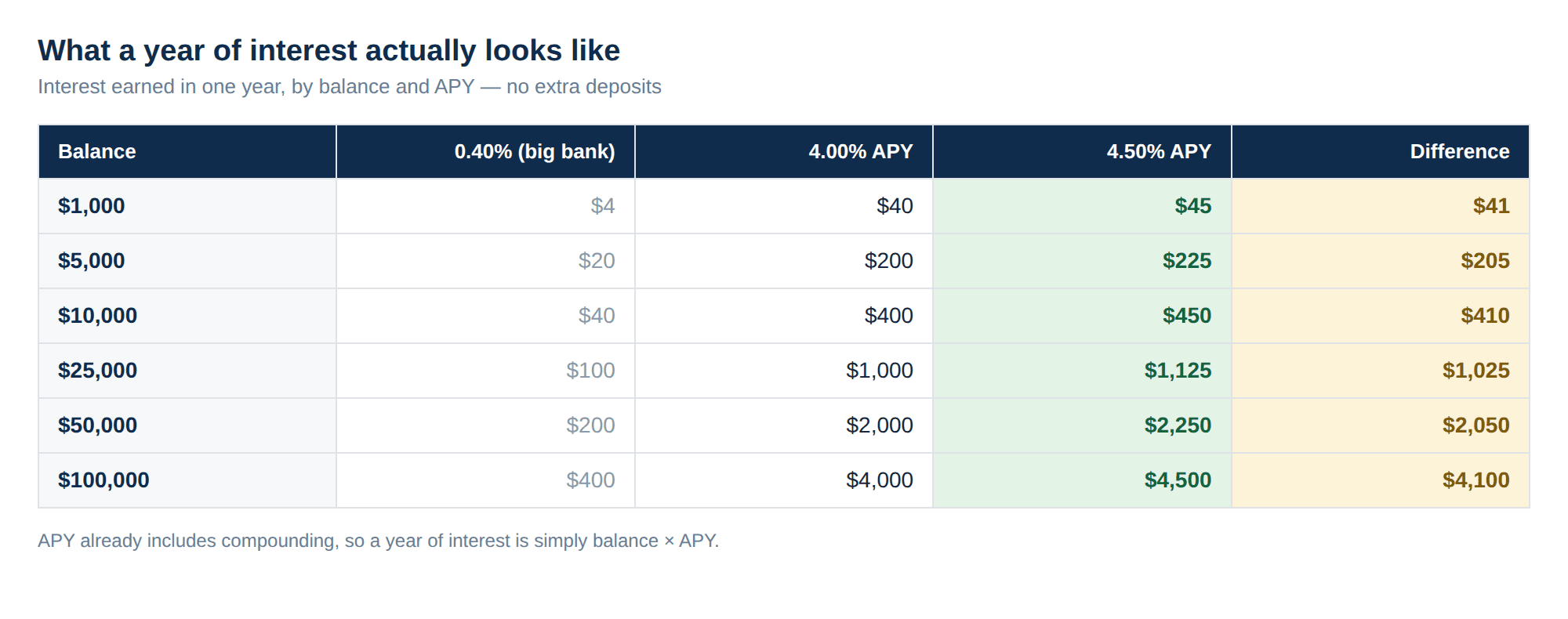
The pattern worth noticing: the gap scales with the balance, so the bigger your cash pile the more an afternoon of paperwork is worth. At $100,000 the difference between a big-bank account and a competitive one is $4,100 a year for doing nothing differently.
APY vs interest rate — what's the difference?
The interest rate (sometimes called the nominal rate) is the headline number before compounding. The APY — annual percentage yield — is what you actually end up with after a year of that compounding.
APY is always the higher of the two, and it is the one to compare between banks, because it is the only figure that accounts for how often interest is added. A 4.00% rate compounded daily produces an APY of about 4.08%. This calculator converts APY into an effective monthly rate, so the projection matches the yield a bank quotes you.
If you also carry debt, be aware the mirror-image term works against you — see APR vs APY for how the same maths is presented differently when you're the one paying.
Does compounding frequency matter?
Less than the marketing suggests. Banks advertise "compounded daily" as a feature; here is what it is actually worth on $10,000:
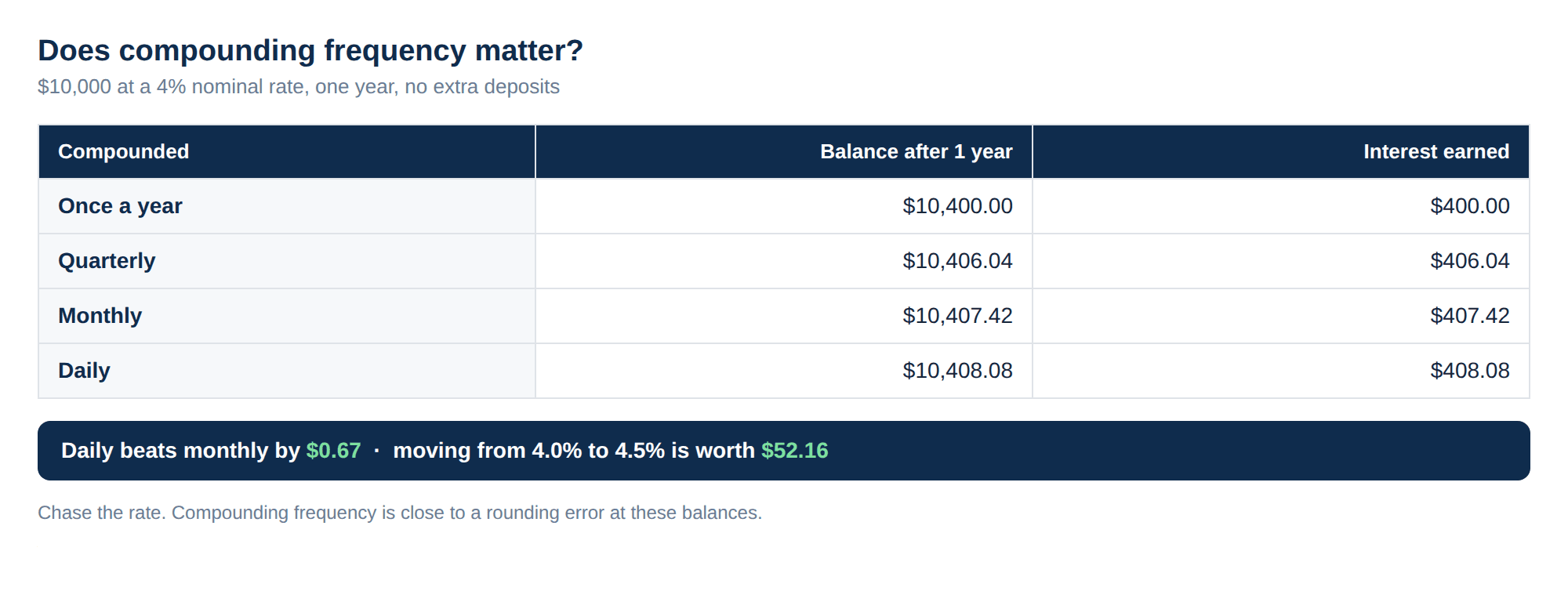
Annual to daily is worth about $8 across the whole year. Monthly to daily — the comparison banks actually advertise — is 67 cents. Meanwhile moving the same money from 4.0% to 4.5% is worth $52, roughly seventy-eight times more.
Compare APYs and ignore the compounding schedule. It is already baked into the APY anyway, which is the entire reason APY exists.
What actually moves your APY
- Central bank rates. The dominant factor. When the Fed cuts, savings rates follow within weeks — usually faster than they rise when it hikes.
- Competition for deposits. Online banks with no branch network pay more because they can, and because deposits are how they fund lending.
- Promotional rates expiring. The most common reason a rate silently drops. An introductory APY reverts after three or six months and nobody emails you about it.
- Balance tiers. Some accounts pay a headline rate only up to a cap, then far less above it. Worth checking if your balance is growing.
Because of the first and third points, a rate that was market-leading two years ago is often mid-table now. Checking once a year is enough; never checking is what costs money.
If yours has already dropped, here is why your savings rate dropped and how to tell which cause it was — each of the four has a different fix.
Tax on savings interest
This calculator projects pre-tax growth. In the US, savings interest is taxed as ordinary income — not at the lower rates that apply to long-term investment gains — and your bank reports it on a 1099-INT.
The practical effect: in a 22% federal bracket with 5% state income tax, a 4% APY nets closer to 2.9%. That does not make savings the wrong place for short-term cash, but it does mean the headline rate overstates what you keep.
One exception worth knowing: Treasury bill interest is exempt from state and local income tax, which can beat an identical rate elsewhere once balances get large. The full after-tax comparison of savings, money market, CDs and T-bills works through the numbers.
Where to keep cash so it actually grows
- High-yield savings (HYSA): liquid, federally insured at a bank, and pays meaningfully more than a standard account — the default for an emergency fund.
- Certificates of deposit (CDs): lock money up for a set term in exchange for a fixed rate. Only worth it when you know the date you need the money — or when you build a CD ladder so part of it matures every year.
- Money market accounts: near-identical to savings, more often with cheque-writing or a card.
- Treasury bills: state and local tax exempt, bought through a brokerage rather than a bank app.
When savings is the wrong place
Cash is for money you will need soon, and that is genuinely all it is for. Over long horizons a savings account is close to a guaranteed real-terms loss once inflation is counted — a 4% APY against 3% inflation is a 1% real return before tax, and after tax often less than zero.
Run the erosion on the inflation calculator to see the size of it. Money you genuinely won't touch for five years or more usually belongs invested rather than saved; money you might need next month belongs exactly where this calculator assumes it is.
That raises the obvious follow-up question, which is where the upper bound sits: how much cash is too much cash? Emergencies plus anything with a date in the next few years — and a table showing what the excess is really worth later.
Earn more on your savings
High-yield savings
Compare FDIC-insured online accounts paying some of the highest yields available.
Compare rates →Frequently asked questions
How much interest will $10,000 earn in a year?
At 4.5% APY, about $450. At 4.0%, about $400. At the 0.40% a typical big bank pays, about $40. Because APY already includes compounding, a single year of interest is just your balance multiplied by the APY.
Is savings interest taxable?
In the US, yes — it is taxed as ordinary income rather than at long-term capital gains rates, and your bank reports it on a 1099-INT. In a 22% federal bracket with 5% state tax, a 4% APY nets closer to 2.9%. This calculator shows pre-tax growth.
Does daily compounding beat monthly?
By about 67 cents a year on $10,000 at 4%. It is a real difference but a tiny one. Moving the same money from 4.0% to 4.5% is worth roughly $52 over the same year, so compare APYs and ignore the compounding schedule — it is already reflected in the APY.
What is the difference between APY and interest rate?
The interest rate is the headline figure before compounding; the APY is what you actually earn over a year once compounding is included. APY is always the higher number and is the only one worth comparing between banks, because it is the one that accounts for how often interest is added.
Why did my savings rate drop?
Usually one of two reasons: the central bank cut rates and your bank followed, or an introductory promotional APY expired and reverted to the standard rate. The second happens silently. It is worth checking your rate once a year against what is currently on offer.
Will the APY stay the same?
No. Savings APYs are variable and move with market rates, usually falling faster than they rise. CDs lock a fixed rate for their term, which is the trade-off for giving up access. Treat any projection beyond a year as an estimate rather than a forecast.
Should I keep long-term money in savings?
Generally no. A 4% APY against 3% inflation is a 1% real return before tax, and often negative after it. Savings is the right home for an emergency fund and for money you need within a few years; money you will not touch for five years or more usually belongs invested instead.