
How to Build a CD Ladder
To build a CD ladder, split your savings into equal parts and put each into a certificate of deposit with a different term — for example, $25,000 into five $5,000 CDs maturing in one, two, three, four and five years. As each one matures, roll it into a new five-year CD. After five years every rung is earning a five-year rate, yet one of them unlocks every single year.
A CD pays you for leaving money alone, and that is exactly the problem with one big CD: all of it is locked up at once, at one rate, chosen on one day. A ladder is the standard workaround. It doesn't try to pick the best moment. It spreads the decision out so no single moment matters very much.
How a CD ladder works
Here is the classic five-rung version. You split the money once. After that, there's one decision to make per year.
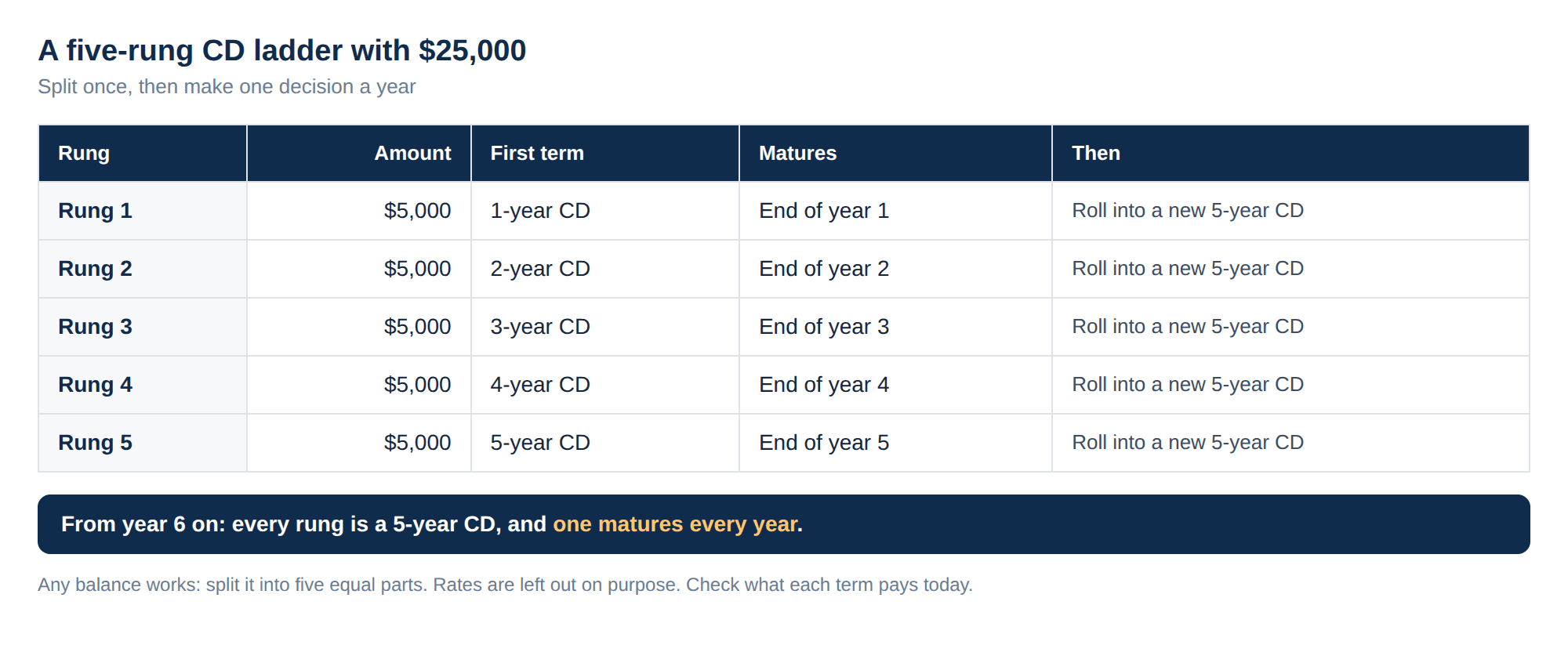
The first five years are the setup. Once the one-year CD matures and rolls into a five-year one, and then the two-year does the same, you eventually hold five five-year CDs with staggered end dates. That's the whole trick: long-term money, annual access.
What a ladder actually solves
A ladder is a compromise, and it's worth being clear about what it gives up. Here's the same $25,000 held three ways:
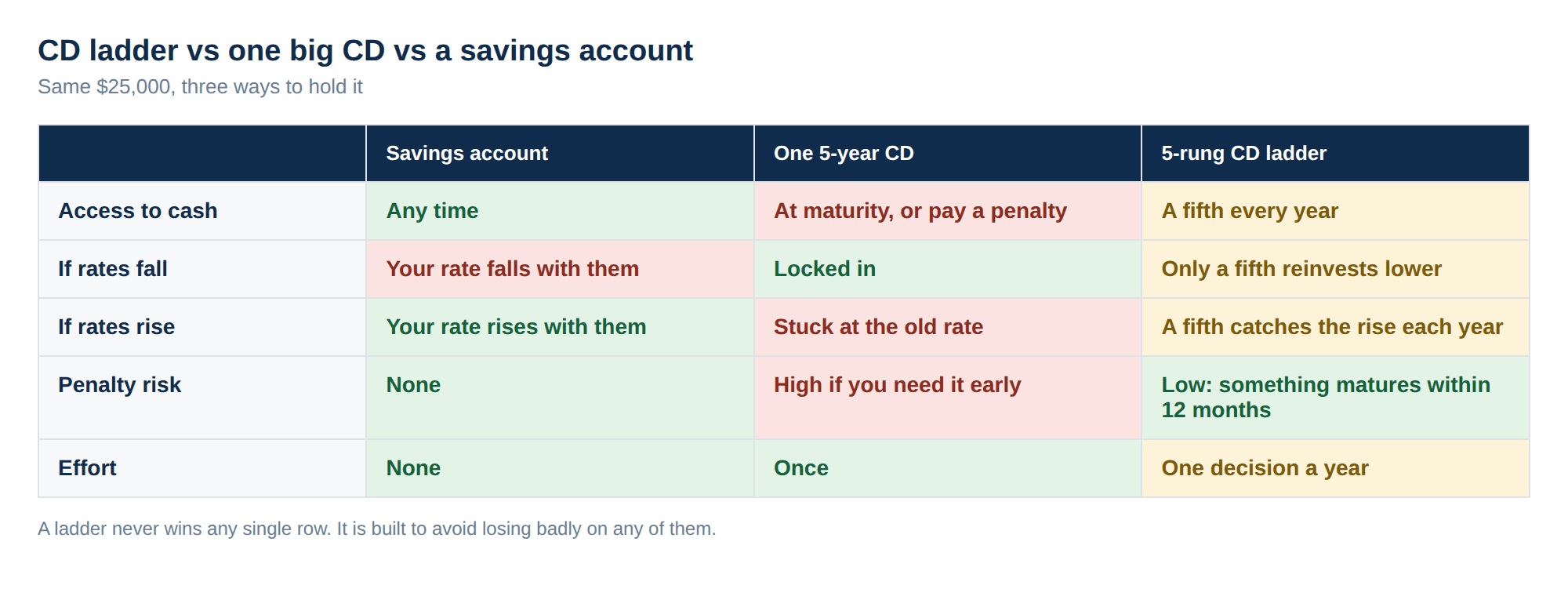
It solves two problems at once. The access problem: with one big CD, needing money early means paying an early-withdrawal penalty on all of it. With a ladder, something matures within twelve months. The timing problem: nobody knows where rates are going. If they fall, only a fifth of your money renews at the lower rate each year. If they rise, a fifth catches the higher rate each year. You're never entirely right, and never entirely wrong.
How to build one, step by step
- Decide how much can be locked up. Only ladder money you won't need at a day's notice. The first few months of your emergency fund belong in an instantly accessible account — see how much cash you actually need.
- Choose rungs and spacing. Five rungs one year apart is the classic. Fewer rungs means less admin; closer spacing means more frequent access.
- Compare rates for every term. Longer terms don't always pay more. When a two-year CD pays the same as a five-year one, there's little reason to lock money up longer, and a shorter ladder may make more sense.
- Open the CDs. They can all be at one bank or spread across several. Deposit insurance limits apply per depositor, per bank, so large ladders are sometimes split across banks for that reason.
- Set a reminder for every maturity date. This is the step people skip. Many CDs automatically renew into the same term at whatever rate the bank then offers. There's usually a short grace period after maturity to move the money without penalty — check the length in your terms.
The short ladder: 3, 6, 9, 12 months
The same idea works on a shorter timescale. Split the money into four CDs of three, six, nine and twelve months, and roll each maturing one into a new twelve-month CD. You get access to a quarter of the money every three months.
This suits money with a rough rather than exact date — a house deposit you expect to need in a year or two, for instance — where a five-year ladder would be too long, but leaving everything in savings means accepting whatever the savings rate does. If you're weighing a ladder against the alternatives, savings vs money market vs CD vs T-bills compares all four on access and tax.
What your ladder will earn
A ladder's return is simply the combined interest of its rungs. Enter each rung's amount, rate and term into the savings interest calculator to see how much interest you will earn on each, then add them up. Running the same total at a high-yield savings rate is the fairest comparison: if the difference is small, the simpler option probably wins.
Run the numbers first
Savings Interest Calculator
See what each rung earns before you commit to a term.
Open calculator →When a ladder isn't worth it
- The balance is small. Five accounts and five reminder dates for a few thousand dollars is a lot of admin for very little difference.
- Savings pays about the same. When a high-yield savings account matches the CD rates, it gives you the same return with instant access and no penalty.
- You might need all of it. A ladder assumes most of the money stays put. If there's a real chance you need the lot, keep it liquid.
- It's really long-term money. Money you won't touch for well over five years may belong invested rather than in CDs — that's a separate decision from which cash account to use.
And if your savings rate has recently fallen, check why your savings rate dropped before deciding a ladder is the fix. Sometimes the simpler answer is just a better account.
Frequently asked questions
What is a CD ladder?
A CD ladder is a set of certificates of deposit with staggered maturity dates, so part of your money becomes available at regular intervals. A classic version splits a sum into five equal CDs of one to five years, then rolls each one into a new five-year CD as it matures.
How much money do you need to build a CD ladder?
There is no fixed minimum beyond each CD's own minimum deposit, which varies by bank. In practice a ladder is most worthwhile when the total is large enough that the effort of managing several accounts is repaid, typically several thousand dollars or more.
What happens when a CD in the ladder matures?
You get a short window, set by the bank, to withdraw the money or move it without penalty. If you do nothing, many CDs automatically renew into a new CD of the same term at whatever rate the bank then offers. In a ladder you usually roll it into the longest rung instead.
Is a CD ladder better than a high-yield savings account?
Not automatically. A ladder protects part of your money from falling rates and can earn longer-term rates while still giving yearly access. A high-yield savings account gives instant access and no penalties. If the account pays about the same as the CDs, the savings account is simpler.
Should my emergency fund be in a CD ladder?
Usually not the first part of it. Money you may need at a day's notice belongs in an instantly accessible account. Some people ladder the portion of a large emergency fund beyond the first few months, since part of it becomes available every year, but early-withdrawal penalties still apply if you need a rung before it matures.