
How Much Cash Is Too Much?
Enough to cover three to six months of essential expenses, plus the full cost of anything you already know you'll pay for in the next two to three years. Anything above that is excess. Cash beyond those two jobs has no job, and it is the one asset almost guaranteed to lose purchasing power slowly.
This is a genuinely uncomfortable question, because holding too much cash never feels like a mistake. The balance only ever goes up. Nothing crashes. The cost is invisible on every statement you'll ever read — which is exactly why it's worth putting a number on.
The two jobs cash has
Cash earns its place when it's doing one of exactly two things: covering what you can't predict, or covering what you can.
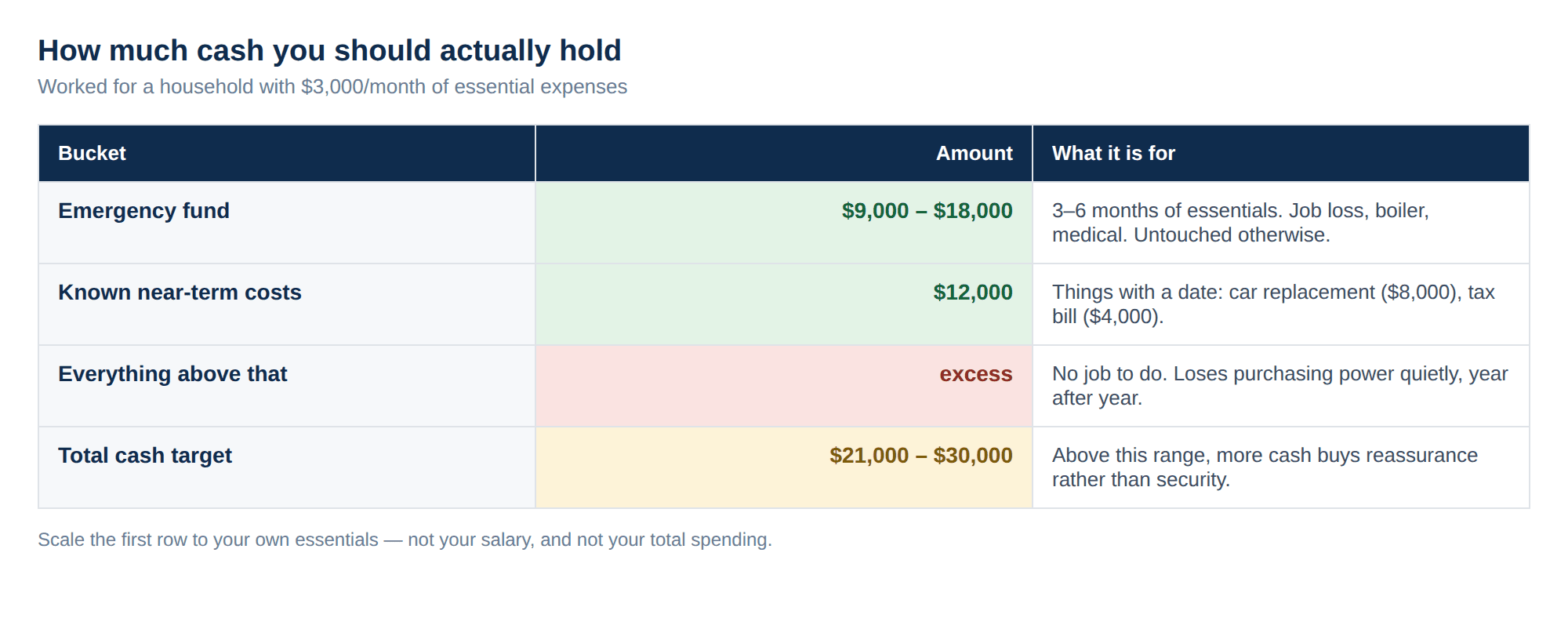
- The emergency fund. Three to six months of essential expenses — rent, food, utilities, transport, minimum debt payments. Not your salary, and not your total spending. Most people overestimate this because they anchor on income. Size it properly with the emergency fund calculator.
- Known near-term costs. Anything with a date attached in the next two to three years: a car you'll replace, a tax bill, a wedding you've said yes to. If it has a date, it belongs in cash regardless of what cash pays.
Add those together and you have your number. For the household above it's roughly $21,000 to $30,000. Above that range, more cash buys reassurance rather than security — and those are not the same thing.
What excess cash actually costs
Here is the part that never shows up on a statement. This assumes no investment returns at all — it is purely what happens to purchasing power when your after-tax return sits below inflation:
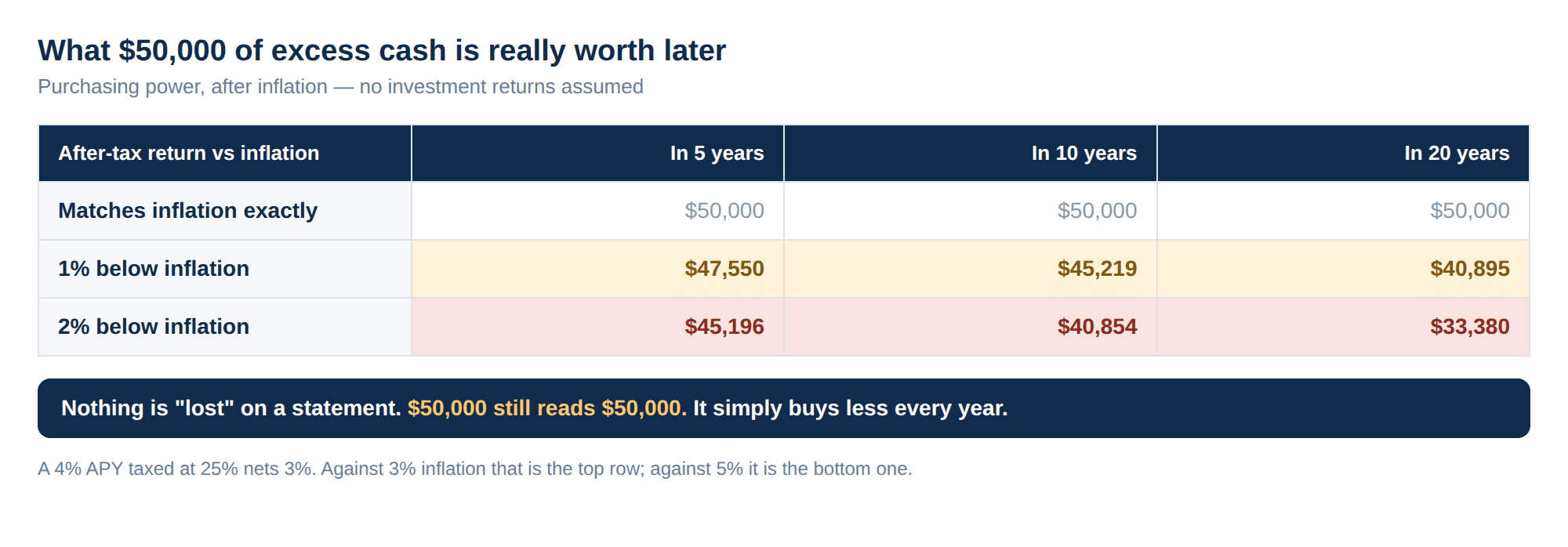
A 4% APY taxed at 25% nets about 3%. Against 3% inflation that's the top row — roughly break-even. Against higher inflation it's one of the lower rows, and $50,000 quietly becomes $40,000 of real spending power over twenty years.
You can see the erosion directly on the inflation calculator, and check what your own balance actually earns first on the savings interest calculator.
Signs you're holding too much
- You can't say what it's for. The cleanest test. If a chunk of cash has no named job, it's excess by definition.
- It's been growing for years without a target. Saving with no endpoint is a habit, not a plan.
- You're saving toward a goal more than five years out. Cash is a poor five-year vehicle and a terrible ten-year one.
- It's several times your annual essential spending. Past a point, more months of runway stops changing any decision you'd make.
Signs you're holding too little
Worth stating plainly, because the opposite error does more damage in the short run — and faster.
- An unexpected $1,000 bill would go on a credit card.
- You've sold something, or paused a contribution, to cover a normal surprise.
- Your income is variable and you're holding a fixed-income-sized buffer — see budgeting on an irregular income for why that needs more, not less.
- Your job is genuinely less secure than average. Runway is worth more than yield when the risk is real.
Being over-cashed costs you a few percent a year. Being under-cashed costs you high-interest debt at the worst possible moment. If you're unsure which way to err, err toward more cash.
Run your numbers
Savings Interest Calculator
See what your current balance actually earns in a year.
Open calculator →High-yield savings accounts
The cash you should be holding may as well earn something.
Compare rates →What to do with the excess
Decide the horizon first, then the destination. Doing it the other way round is how people end up with money in the wrong place and no way to explain why.
- Needed within 2 years: keep it in cash. Make sure it's earning a competitive rate, but don't reach for yield with money that has a date.
- 2 to 5 years: the genuinely awkward middle. A CD or T-bill maturing near the date fits here better than either a savings account or the market.
- 5 years or more: this is the money that historically belongs invested rather than saved. What that should mean for you depends on your tax situation, existing accounts and risk tolerance — things a general article genuinely cannot know about you.
If you carry high-interest debt, that usually outranks all of this. A credit card at 22% is a guaranteed 22% return for paying it down, which no savings account will ever match — see paying off debt vs investing.
The honest part
Most people holding too much cash know it. They're not confused about inflation; they're managing anxiety, and cash is very good at that.
That's worth naming rather than lecturing about, because the usual advice — "you're losing money to inflation!" — misses why the behaviour persists. A slightly oversized cash pile that lets you sleep is not a financial failure. It's a price you're choosing to pay, and it's a reasonable one to choose knowingly.
The goal isn't to hold the theoretically optimal amount. It's to hold an amount you picked on purpose, for stated reasons, rather than one that simply accumulated.
Frequently asked questions
How much cash should I keep?
Enough to cover three to six months of essential expenses, plus the full cost of anything you already know you will pay for in the next two to three years. For a household with $3,000 a month of essentials and a car replacement coming, that is roughly $21,000 to $30,000. Scale the first part to your essentials, not to your salary.
How much cash is too much?
Any amount beyond your emergency fund and your known near-term costs. That money has no job to do, and cash is the one asset almost guaranteed to lose purchasing power slowly. The nominal balance never falls, which is exactly why the loss is easy to miss.
Does holding cash actually lose money?
Not in nominal terms — the statement figure never drops. But if your after-tax return is below inflation, the purchasing power falls every year. $50,000 returning 1% below inflation is worth about $45,200 in today's money after ten years, and roughly $40,900 after twenty.
Is a high-yield savings account enough to beat inflation?
Often only barely, and sometimes not at all. A 4% APY taxed at 25% nets about 3%. Against 3% inflation that is roughly break-even in real terms; against higher inflation it is a slow loss. That is fine for money you need soon and a poor deal for money you do not.
What should I do with excess cash?
Start by deciding the time horizon rather than the product. Money needed within a couple of years should stay in cash regardless of what it earns. Money you genuinely will not touch for five years or more is usually better invested, though what that means for you depends on circumstances a general article cannot know.