
Why Did My Savings Rate Drop?
A savings rate drops for one of four reasons: the central bank cut rates and your bank followed, an introductory promotional rate expired, your balance grew past a cap on the headline rate, or the bank launched a newer version of your account and left you on the old one. Only the first is out of your hands. The other three are fixable in an afternoon.
Nobody emails you when it happens. The balance still goes up every month, just more slowly than it should. Here is how to work out which of the four happened to you, and what the gap is actually costing.
Which one happened to you?
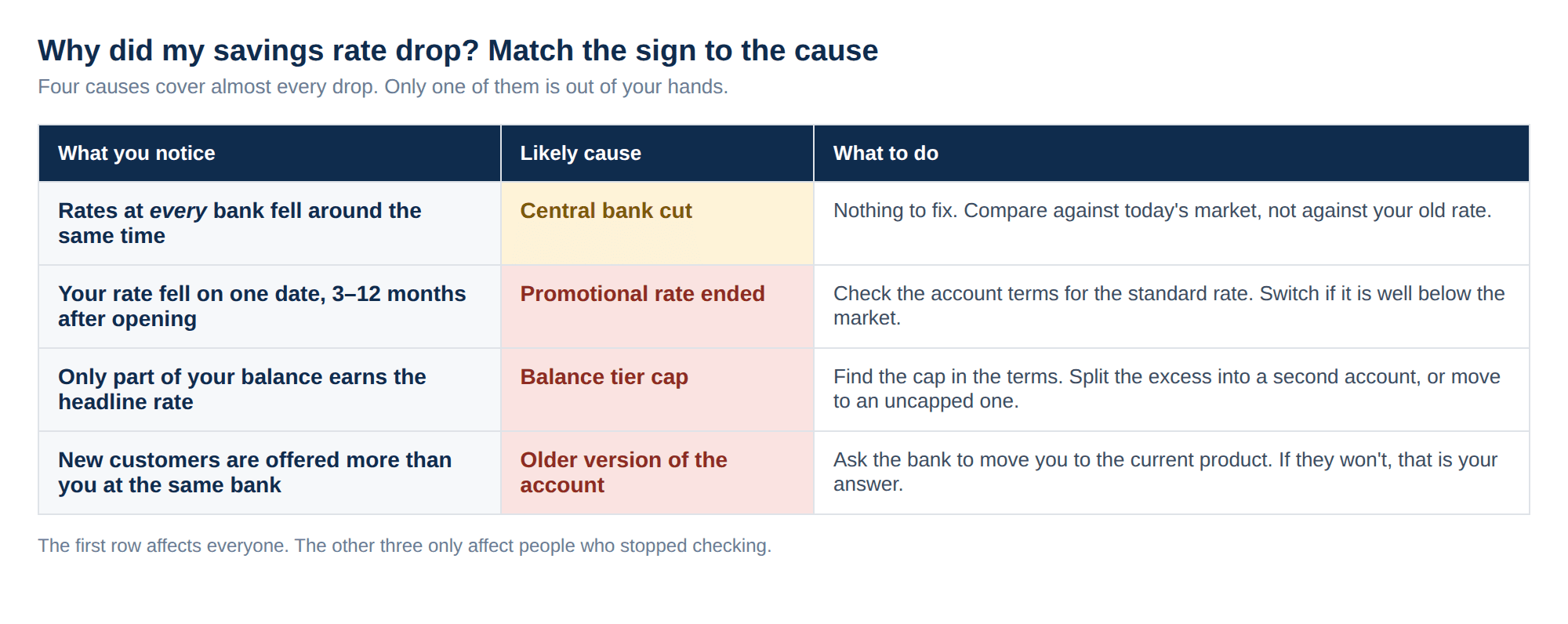
Each cause leaves a different fingerprint. Match what you noticed to the left-hand column:
1. The central bank cut rates
Savings accounts pay a variable rate, and that rate tracks the central bank's. When the Fed cuts, banks follow, usually within weeks, and often faster than they passed on the rises.
The tell: rates fell across the market at roughly the same time, not just at your bank. There is nothing to fix here, but there is one trap. Don't compare your new rate against your old one — compare it against what competitive accounts pay today. If you're still near the top of the current market, you're fine.
2. Your promotional rate ended
This is the most common cause of a sudden drop on one specific date. Many accounts advertise an introductory or bonus rate for the first three, six or twelve months, after which the balance reverts to the standard rate — sometimes a fraction of the headline.
The tell: the drop landed on a single date a few months after you opened the account, and other banks' rates didn't move that week. The end date and the standard rate are in the account terms or the welcome email. If the standard rate is well below the market, that account has done its job and it's time to move.
3. You crossed a balance cap
Some accounts pay the headline rate only up to a limit and far less above it. Nothing about your rate "changed" — your balance grew into the lower tier.
A worked example: an account paying 4% on the first $10,000 and 1% above it. At a $25,000 balance you earn $400 on the first tier and $150 on the rest — $550 a year, which is an effective rate of 2.2%, barely half the number on the advert.
The tell: your interest stopped growing in line with your balance. The fix is either an account with no cap, or keeping the capped account at its limit and holding the rest elsewhere.
4. You're on an older version of the account
Banks sometimes launch a new savings product at a higher rate while leaving existing customers on the older one, which quietly slides down the table. Your account still works, still pays interest, and never tells you there's a better version at the same bank.
The tell: the bank's own website advertises a rate you don't get. Ask to be moved to the current product. If they won't, that's your answer.
What the gap costs you
The cost of an uncompetitive rate is simple arithmetic: your balance multiplied by the gap between your rate and a competitive one.
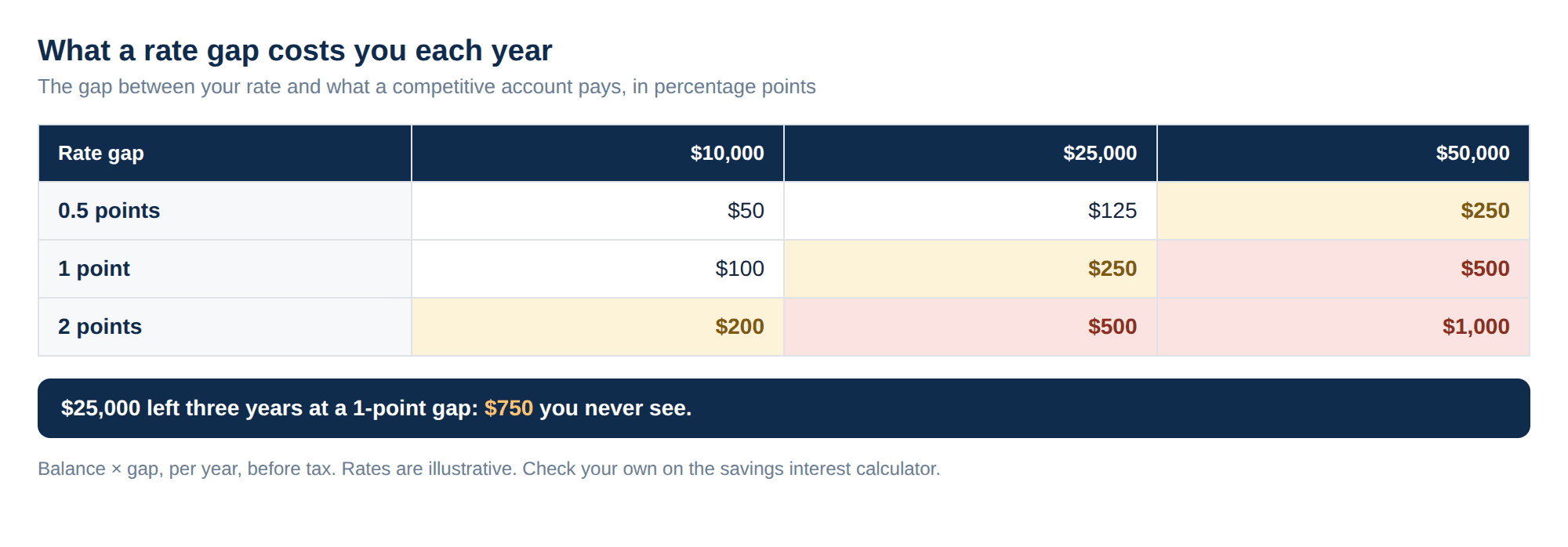
A one-point gap on $25,000 is $250 a year. Left alone for three years, that's $750. To see what your own balance should be earning, run it through the savings interest calculator at your current rate and again at a competitive one; the difference is the real cost.
Earn a competitive rate
Savings Interest Calculator
See how much interest you will earn at your rate versus today's.
Open calculator →High-yield savings accounts
Check what competitive accounts are paying right now.
Compare rates →How to check in five minutes
- Find your current APY. It's in your banking app or on your latest statement. Use the APY, not the interest rate — the difference is explained here.
- Find what a competitive account pays today. Look at a few online high-yield savings accounts, not your bank's own advert.
- Subtract, then multiply by your balance. That's your yearly cost, before tax.
- Check which of the four causes applies using the table above. It tells you whether to switch, ask, or split.
Put a reminder in your calendar for the same week every year. That single habit is worth more than any amount of rate-chasing.
When not to switch
- The gap is small for your balance. A quarter-point gap on $5,000 is about $12 a year. Not worth your afternoon.
- You'd be chasing a teaser. A new account with a six-month bonus rate will revert just like the last one. Look at the standard rate, not the headline.
- You need the money soon. If a large known payment is due in the next few weeks, don't move it and risk a transfer delay at the wrong moment.
- It's in a fixed-rate CD. That rate is locked; the drop you're seeing elsewhere doesn't apply until it matures. If you're weighing the options, see savings vs money market vs CD.
And if you're holding far more in savings than you need, a better rate is only half the answer — how much cash is too much covers the other half.
Frequently asked questions
Why did my savings account interest rate go down?
Almost always one of four reasons: the central bank cut rates and your bank followed, an introductory promotional rate expired, your balance grew past a tier cap that pays the headline rate, or the bank launched a newer version of the account and left you on the old one. Only the first affects everyone. The other three are fixable.
Can a bank lower my savings rate without telling me?
Yes. Savings rates are variable by design, and the account terms you agreed to when opening allow the bank to change the rate. Promotional rates reverting to the standard rate on their end date are rarely announced prominently. That is why checking once a year matters.
How do I know if my savings rate is still competitive?
Find your current APY in your banking app or latest statement, then compare it with what competitive high-yield accounts are paying today. If the gap is more than about half a percentage point on a meaningful balance, it is usually worth moving.
Is it worth switching banks for a higher savings rate?
Multiply your balance by the rate gap. At $25,000, a one-point gap is about $250 a year. Opening an online account and moving the money typically takes under an hour of work. For small gaps on small balances it may not be worth it; for larger balances left unchecked for a few years, it usually is.
Should I move my savings every time a better rate appears?
No. Chasing every new teaser rate costs time and creates admin for small gains, and teaser rates revert. A reasonable rule is to check once a year and move only when the gap is meaningful for your balance.