A real example: $30,000 over 10 years
Say you graduate owing $30,000 at a 6% interest rate on a standard 10-year plan. Here's what that actually costs:
- Monthly payment: about $333
- Total interest paid: about $9,970
- Total repaid: about $39,970
Now add just $50 extra each month (a $383 payment). You'd be debt-free about 20 months sooner and save roughly $1,800 in interest. That's the power of paying a little extra — plug your own balance and rate into the calculator above to see your numbers.
How your monthly payment is calculated
A student loan is an amortizing loan: each fixed monthly payment covers that month's interest first, and whatever is left chips away at the balance (the principal). Early on, most of your payment goes to interest; as the balance shrinks, more of each payment attacks the principal, so the loan pays off faster and faster near the end. Three things drive the payment: your balance, your interest rate, and your repayment term. A longer term lowers the monthly payment but raises the total interest, because you're borrowing the money for more years.
Longer term, lower payment: what it really costs
The repayment term is the single biggest lever on what your loan costs, and it pulls in the opposite direction to your monthly budget. Here is the same $30,000 at 6% over four terms:
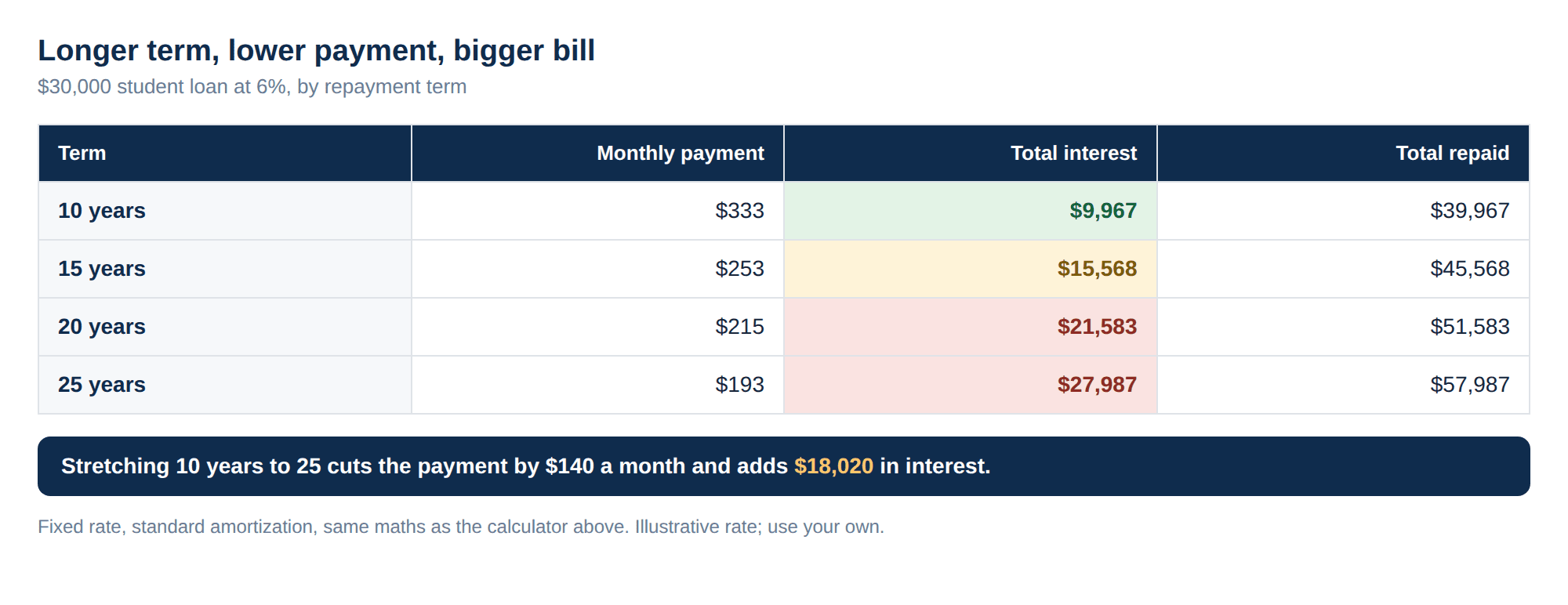
The 25-year payment is 42% lower, but the interest is 2.8 times higher. That's not a reason never to choose a longer term: if the standard payment genuinely doesn't fit, a payment you can keep up beats one you can't. But it's worth choosing knowingly, and the best version of a long term is one you overpay whenever you can, since it lets you pay it off like a shorter loan while keeping the lower required payment as a safety net.
What extra payments actually do
Going the other way, small extra payments toward principal shorten the loan dramatically. On the standard 10-year plan:
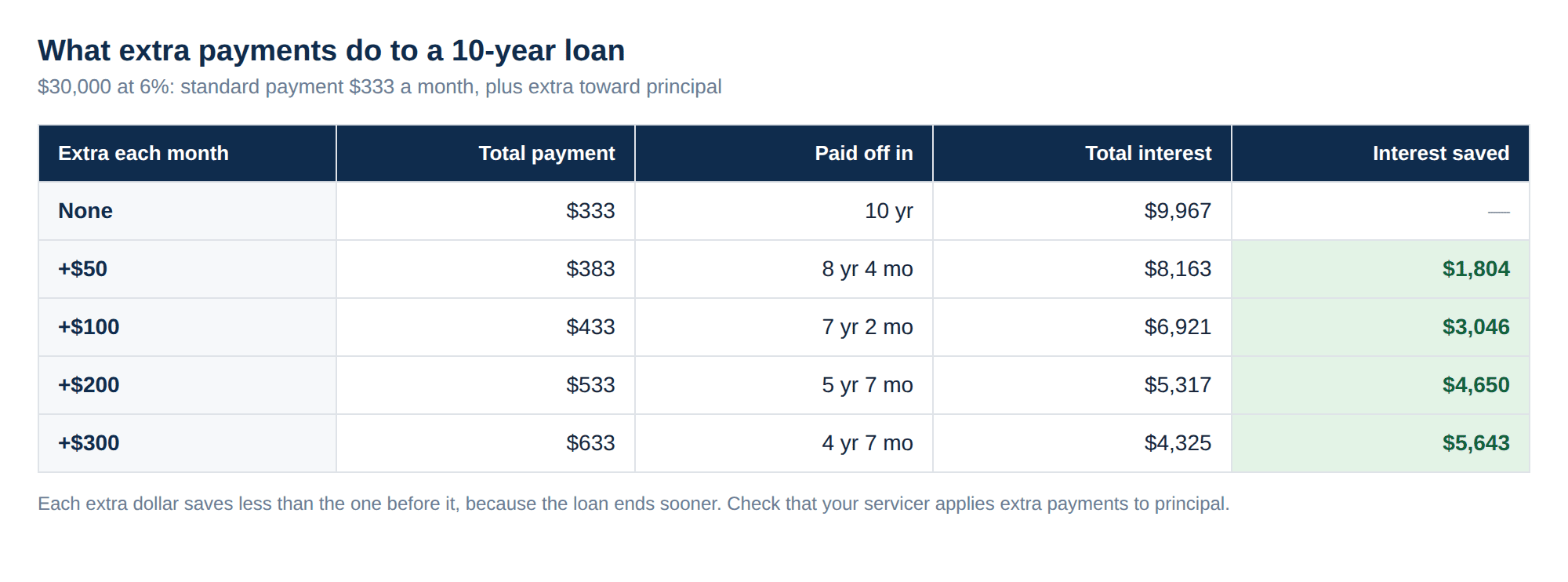
Notice the returns shrink as you add more. The first $50 a month saves about $36 of interest for every dollar of monthly extra; at $300 it's about $19. The early extra dollars do the heavy lifting, which is good news if you can only spare a little. Even $50 a month takes 20 months off the loan.
One practical catch: some servicers treat an overpayment as paying your next bill early rather than reducing the balance. Check that extra money is applied to principal, or the savings in this table won't happen. The guide to paying off student loans faster covers how to set that up.
How to pay off student loans faster
- Pay extra toward principal. Every dollar above the minimum goes straight at the balance and saves future interest — try raising the "extra payment" above.
- Target the highest rate first. If you have multiple loans, throw extra money at the one with the highest interest rate (the avalanche method).
- Consider refinancing. If you have strong credit and stable income, refinancing to a lower rate can cut total interest — though for federal loans, weigh the loss of federal protections first.
For the full step-by-step plan — including the servicer trick that makes sure extra payments actually reduce your balance — read the guide: How to Pay Off Student Loans Faster.
Should you rush it?
Student loan rates are often moderate. If your rate is low, you might do better investing extra money instead of overpaying — see pay off debt or invest? and compare with the compound interest calculator.
When this calculator's answer can mislead you
- Federal repayment plans and forgiveness. Federal loans can come with income-driven repayment and forgiveness programs, whose rules change from time to time. This calculator assumes a fixed payment until the balance hits zero, so it can't model those. Check your options at studentaid.gov before choosing a plan or refinancing.
- Your balance isn't what you borrowed. Interest can build up during school or a deferment and be added to the balance. Enter your current balance from your servicer, not the amount you originally took out.
- Several loans at different rates. One blended rate hides which loan is costing you most. Run each loan separately, then put any extra money toward the highest rate first.
- Variable rates. Some private loans have rates that can rise. The calculator holds the rate fixed for the whole term, so treat a variable-rate result as a best case if rates go up.
- A payment below the monthly interest. At 6%, a $30,000 balance builds about $150 of interest a month. Pay less than that and the balance never falls, which is why the calculator shows "Payment too low".
Refinancing federal loans into a private loan can lower your rate, but it permanently gives up the federal repayment options above. That trade is worth making only with eyes open.
Lower your rate
Compare refinance rates
A lower rate can save thousands over the life of your loans.
Check rates →Budget your payments
Fit your loan payment into a simple plan with the 50/30/20 rule.
Open budget tool →Frequently asked questions
Is this for federal or private loans?
The math works for both. Federal loans offer income-driven plans and forgiveness options this simple calculator doesn't model, so treat it as an estimate.
Why does a longer term cost more?
Lower monthly payments mean you borrow the money for longer, so more interest accrues overall. Switch the term above to see the difference.
How much does paying $100 extra a month save on student loans?
On a $30,000 loan at 6% over 10 years, an extra $100 a month pays it off in 7 years 2 months instead of 10 and saves $3,046 in interest. Enter your own balance and rate above to see your figure.
Is it better to choose a longer repayment term for a lower payment?
Only if the shorter-term payment genuinely does not fit your budget. On $30,000 at 6%, going from 10 years to 25 lowers the payment from $333 to $193 a month but raises total interest from $9,967 to $27,987. A longer term you overpay when you can is a reasonable middle ground.
What does “payment too low” mean?
Your payment is smaller than the interest charged each month, so the balance would never go down. Raise the payment or shorten the term until the calculator shows a payoff date.
Can I use this calculator for several student loans at once?
Run each loan separately with its own balance and rate. A single blended rate hides which loan costs the most, and extra payments do the most good on the highest-rate loan.
Should I pay off student loans early or invest?
It depends largely on your interest rate. Paying off a loan earns a guaranteed return equal to its rate, while investing returns are not guaranteed. Many people prioritise any employer retirement match first, then compare their loan rate with what they could reasonably expect from investing.