
Savings vs Money Market vs CD vs T-Bills
Choose on when you need the money, not on which rate is highest today. Cash you might need at any moment belongs in a high-yield savings or money market account. Cash with a known date can go into a CD. Larger balances in a state with income tax often keep the most in Treasury bills, because T-bill interest is exempt from state and local tax.
Rates change weekly and every comparison table built around them is out of date by the time you read it. Access and tax treatment don't change — so those are what this compares.
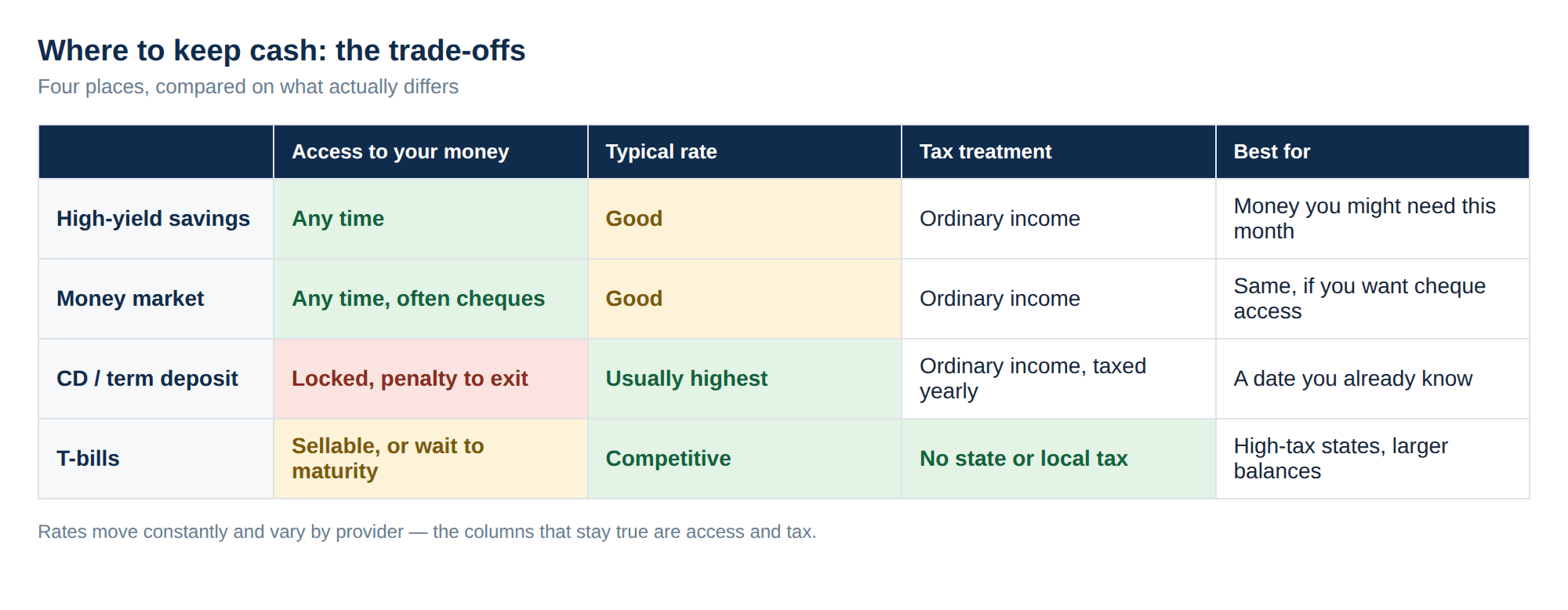
High-yield savings
The default, and correctly so for most cash. Money is available the same day or next, it's federally insured at a bank, and the rate is typically many multiples of what a big high-street bank pays on its standard savings account.
The catch is that the rate is variable — it moves when central bank rates move, and sometimes when the bank simply decides to stop competing. A high-yield savings account that was market-leading two years ago is often mid-table now, which is worth a check once a year rather than never.
Money market accounts
Close enough to savings that the rate on the day usually decides between them. Same instant access, same federal insurance at a bank.
The practical difference is reachability: money market accounts more often come with cheque-writing or a debit card, so the money can be spent without a transfer first. That's genuinely useful for something like a house deposit or a tax bill — and genuinely unhelpful if the friction of a transfer was the thing stopping you spending it.
CDs
A CD pays more precisely because you agree not to touch it. That trade only makes sense when you already know the date.
- Good: a tax bill due in March, a car you're replacing next spring, a deposit on a house with an agreed completion.
- Bad: an emergency fund. Its entire job is being available on the day something goes wrong, which is the one thing a CD is not.
Two details people miss. Breaking a CD early forfeits a defined chunk of interest — commonly several months' worth — which can wipe out the advantage that made you choose it. And on a multi-year CD you generally owe tax on the interest each year it accrues, not when the CD matures, so the tax bill can arrive before the money does.
Run your numbers
Savings Interest Calculator
See exactly how much interest you will earn at any rate and balance.
Open calculator →High-yield savings accounts
Rates move constantly — it is worth checking yours once a year.
Compare rates →T-bills and the tax quirk
Treasury bills are short-term government debt, bought at a discount and redeemed at face value — the difference is your interest. They're backed by the US government rather than FDIC-insured, which for this purpose is at least as strong.
The reason they belong in this comparison is tax. T-bill interest is exempt from state and local income tax (you still owe federal). Against an identical headline rate, that exemption is free money in any state that taxes income — and worth nothing at all in a state that doesn't.
The trade-offs: you buy them through a brokerage or TreasuryDirect rather than a bank app, and getting out before maturity means selling at whatever the market pays that day.
The same rate, different outcomes
Put $25,000 into each at an identical 4%, in a 22% federal bracket and a state with 5% income tax:
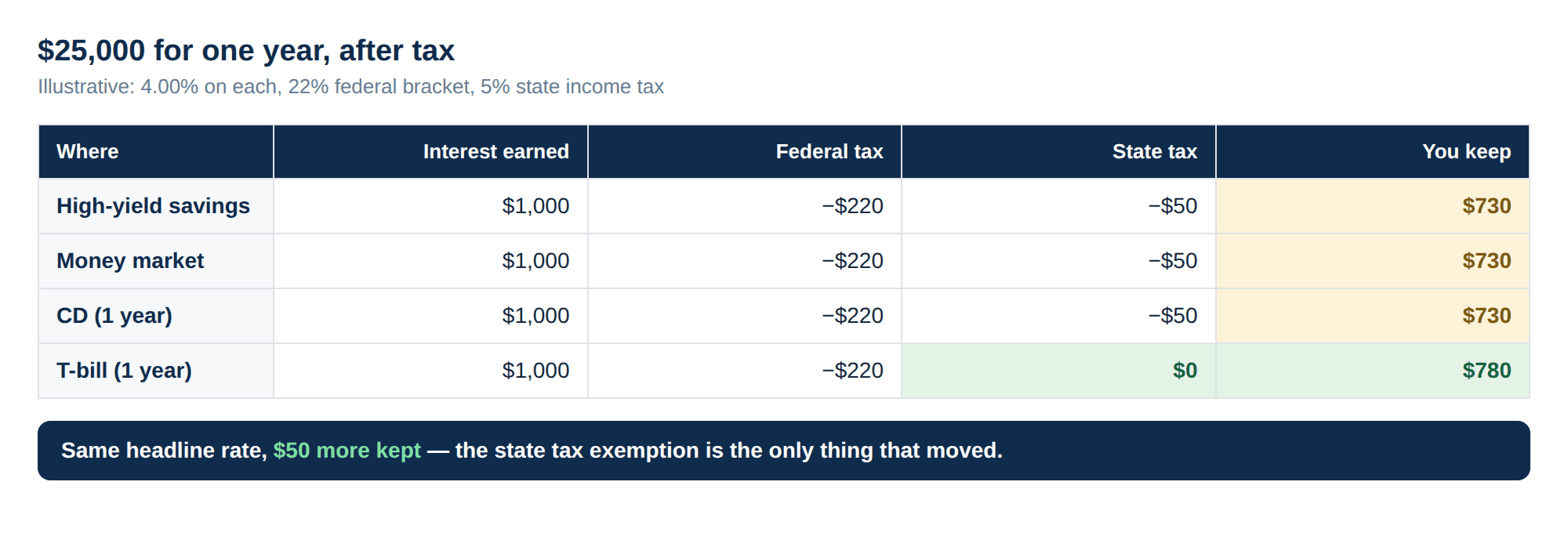
Fifty dollars on $25,000 sounds minor, and on $25,000 it is. Scale it to $100,000 and it's $200 a year for holding the same cash at the same rate — which is the point at which the extra step of buying through a brokerage starts paying for itself.
Worth being clear about what this example does not show: it holds the rate equal to isolate the tax effect. In practice the four options rarely offer the same rate on the same day, and a half-point difference in rate swamps the tax difference entirely. Check both, in that order. You can run any rate and balance through the savings interest calculator to see what you'd actually earn before tax.
How to actually decide
Three questions, in order:
- Might I need this at no notice? Then savings or money market, and stop there. Nothing else is worth the penalty risk.
- Do I know the date? Then a CD or a T-bill maturing near it. Match the term to the date rather than chasing the longest term with the best rate.
- Is the balance large and do I pay state income tax? Then price the T-bill against the others after tax, not on the headline rate.
And one thing that outranks all three: the gap between a big-bank savings account paying almost nothing and any competitive option here is far larger than the gap between the four options themselves. Moving the money at all matters more than which of these you move it to.
Frequently asked questions
Where is the best place to keep cash savings?
It depends on when you need the money, not on which headline rate is highest. For cash you might need at any moment, a high-yield savings account or money market account wins because there is no penalty for taking it out. For a date you already know, a CD usually pays more. For larger balances in a state with income tax, Treasury bills often keep you the most after tax because their interest is exempt from state and local tax.
Is a money market account better than a savings account?
They are close enough that the rate on the day usually decides it. Both let you withdraw whenever you want and both are federally insured at a bank. The practical difference is that money market accounts more often come with cheque-writing or a debit card, which matters if you want the money reachable without a transfer first.
Are CDs worth it?
Only when you genuinely know the date you need the money. A CD typically pays more than savings precisely because you agree not to touch it, and breaking one early costs you a chunk of the interest. If there is real uncertainty about the timing, the extra fraction of a percent is rarely worth the penalty risk.
Why are Treasury bills more tax-efficient?
T-bill interest is exempt from state and local income tax, though you still pay federal tax on it. On $25,000 earning 4% in a state with a 5% income tax, that exemption is worth about $50 a year against an identical rate elsewhere. In a no-income-tax state the advantage disappears entirely.
Should I keep my emergency fund in a CD?
Generally no. An emergency fund's whole job is to be available on the day something goes wrong, and a CD is defined by not being available. Keep the emergency fund in savings or a money market account, and use CDs or T-bills only for money that has a known date attached to it.