
How to Budget on an Irregular Income
Don't budget your income. Pay yourself a fixed salary out of a buffer account and budget that instead. All income lands in the buffer; on the same day each month you transfer the same amount to your spending account. Good months refill the buffer, lean months draw it down, and the budget itself never changes.
Every budgeting rule you've read — 50/30/20, zero-based, envelopes — quietly assumes a paycheck that arrives on the same date for the same amount. Freelancers, contractors, commission earners, tipped workers and anyone on variable shifts are excluded by the first sentence. The fix isn't a different rule. It's a layer underneath the rule.
Why budgeting the average fails
The instinctive move is to average the last year and budget from that. It fails for a reason that's obvious once you see it: you don't live in the average, you live in the months.
Here's a real-shaped year. Average monthly income is about $3,425 — a perfectly comfortable number. Now look at what's actually spendable each month if you budget the income directly:
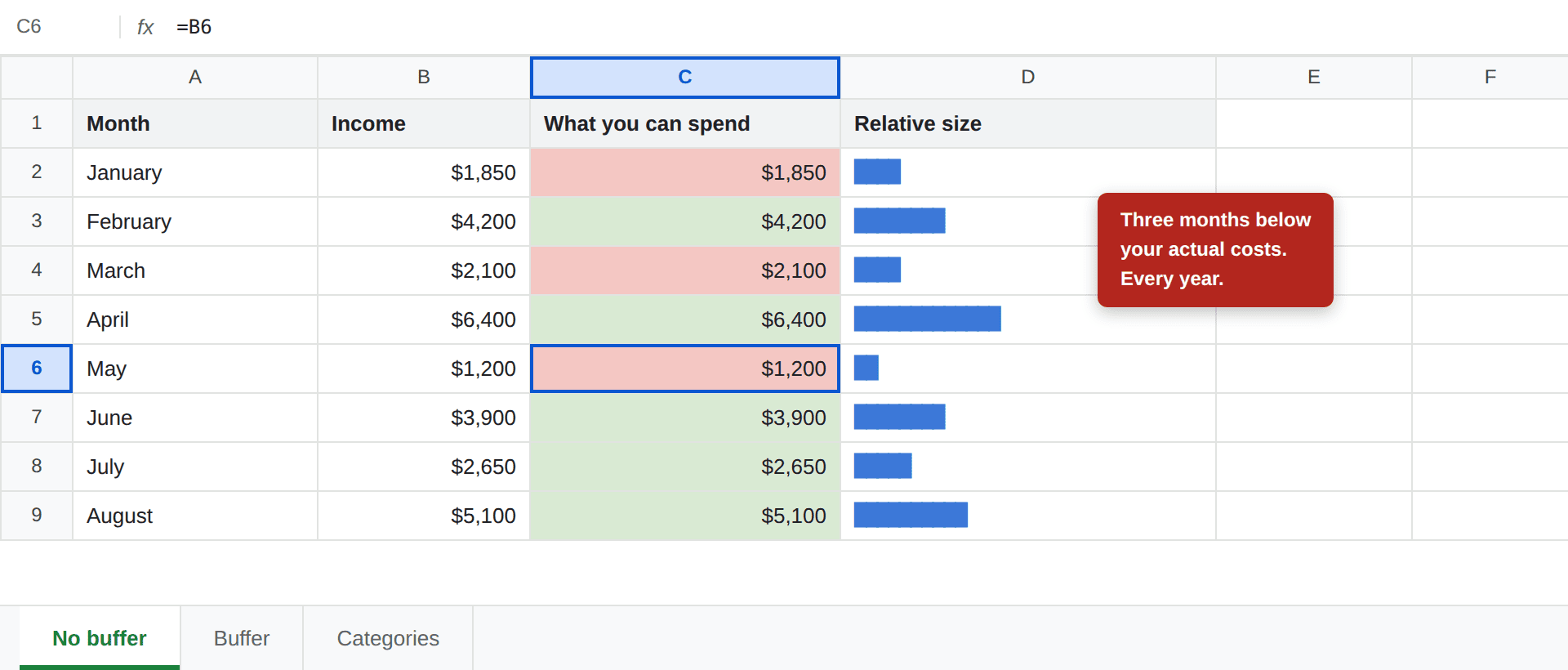
January, March and May are short. Not because the year was bad — the year was fine — but because the money arrived in the wrong order. Meanwhile the surplus in April and August gets quietly absorbed, because a month with $6,400 in it doesn't feel like a month to economise.
That's the whole trap: lean months create debt, good months don't repay it. Averaging describes your year accurately and helps you not at all.
Step 1: Set your salary
Pick the number from your lowest months, not your average. Take the last twelve months of income, find the three lowest, and set your salary at roughly that level.
In the example above, the three lowest months are $1,200, $1,850 and $2,100 — averaging about $1,717. A salary of $2,800 sits above that, which is fine, because the buffer covers the gap. The rule isn't "salary must equal your worst month"; it's the further above your worst months you set the salary, the bigger the buffer has to be.
It will feel too low. Set it anyway. A salary you can pay every single month is worth far more than one you have to skip twice a year, because the entire point is that your budget stops being a variable.
Once you have that number, split it like any fixed income — the 50/30/20 calculator works normally now, because you finally have a fixed income to split.
Step 2: Build the buffer
The buffer is a separate account with no card attached. It exists to be boring. Three rules:
- All income lands here first. Every invoice, every commission cheque, every shift. Nothing is paid directly into the account you spend from.
- One transfer out per month, same date, same amount. This is the salary. Treat it exactly as an employer would — it doesn't move because you had a good week.
- It is not your emergency fund. Keep those separate. A buffer that doubles as an emergency fund gets drained by an ordinary quiet month, and then a real emergency arrives to find nothing there.
Aim for three months of salary in the buffer before you consider the system stable. Getting there is the hard part — it usually means running a deliberately low salary for a few months while the good months bank up.
Step 3: The spreadsheet
The whole thing is one tab and one formula. Log income in, salary out, and let a running balance do the work:
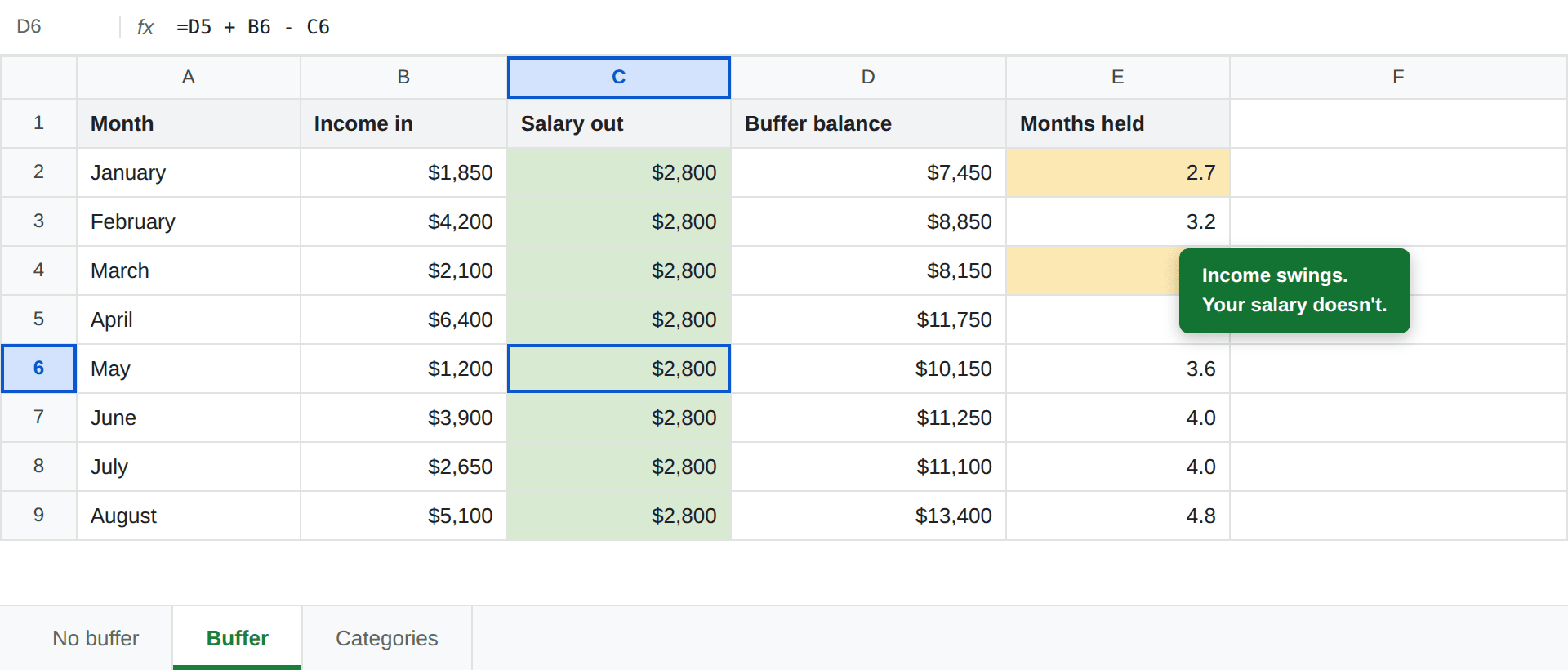
Four columns and you're done:
- Income in — what actually arrived that month.
- Salary out — the same figure every row. If this column ever varies, the system isn't working.
- Buffer balance —
=D5 + B6 - C6, dragged down. Previous balance, plus what came in, minus what you paid yourself. - Months held —
=D6/$C$6. This is the column to actually watch. Conditional formatting turns it amber under 3, so a slow slide is visible months before it becomes a problem.
Notice January and March run at 2.7 and 2.9 months of cover — below target, flagged, and entirely survivable. That's the system working: the warning is on the dashboard rather than in your bank balance.
This sits alongside a normal budget rather than replacing one. The salary feeds your ordinary Google Sheets budget, with its categories and its monthly reset, exactly as a paycheck would.
Run your numbers
Budget template
Add a Buffer tab to it — the categories and dashboard already work.
Make a copy →When to give yourself a raise
The system's one real temptation is raising the salary the moment the buffer looks healthy. Use two conditions instead, and require both:
- The buffer has held at least three months of cover for six consecutive months, and
- Your trailing twelve-month average income comfortably exceeds the new salary — not the last quarter, the last year.
Then raise it by a modest amount and let it settle for another six months. Slow is correct here: every raise you take is a raise you might have to reverse, and reversing a salary is exactly the instability the buffer exists to remove.
If the buffer keeps growing past six months of cover, that's a signal too — you're underpaying yourself, and the surplus would work harder in long-term investments than sitting in a current account.
The tax column freelancers need
If nobody withholds tax for you, add one more column to the buffer tab — and put it before the balance calculation:
Tax set-aside: =B6 * 0.25
Move that amount to a third account the day the income arrives, and subtract it before the buffer balance updates. Use your own rate; the specific percentage matters less than the money leaving before you can see it.
This is the single most common way irregular-income budgets fail. Not overspending — a tax bill arriving against a buffer that was quietly counting money it never owned.
Frequently asked questions
How do you budget when your income changes every month?
Stop budgeting the income and budget a salary instead. Route all income into a separate buffer account, then transfer the same fixed amount to your spending account on the same day each month. Good months top the buffer up, lean months draw it down, and your budget never changes.
How much should I pay myself if my income is irregular?
Start from your lowest months, not your average. Take the three lowest months of the last twelve and set your salary at or just above that level. It will feel too low at first — that is the point. A salary you can always pay is worth more than one you have to skip twice a year.
How big should the buffer be before it works?
Three months of salary is the working minimum, because that is roughly how long a bad stretch lasts before it becomes a crisis. Below three months you are still exposed; above six you can consider raising the salary instead of letting the buffer grow indefinitely.
Is the buffer the same as an emergency fund?
No, and mixing them is the common mistake. The buffer smooths income you expect to receive; the emergency fund covers events you did not expect at all. Keep them in separate accounts, because a buffer that doubles as an emergency fund gets drained by a normal quiet month.
How do I handle tax on irregular income?
Set the money aside the day it arrives, not at year end. Add a column to the buffer tab that takes a fixed percentage off every payment before the balance updates, and move that amount to a third account. Money you owe should never sit in an account you budget from.